
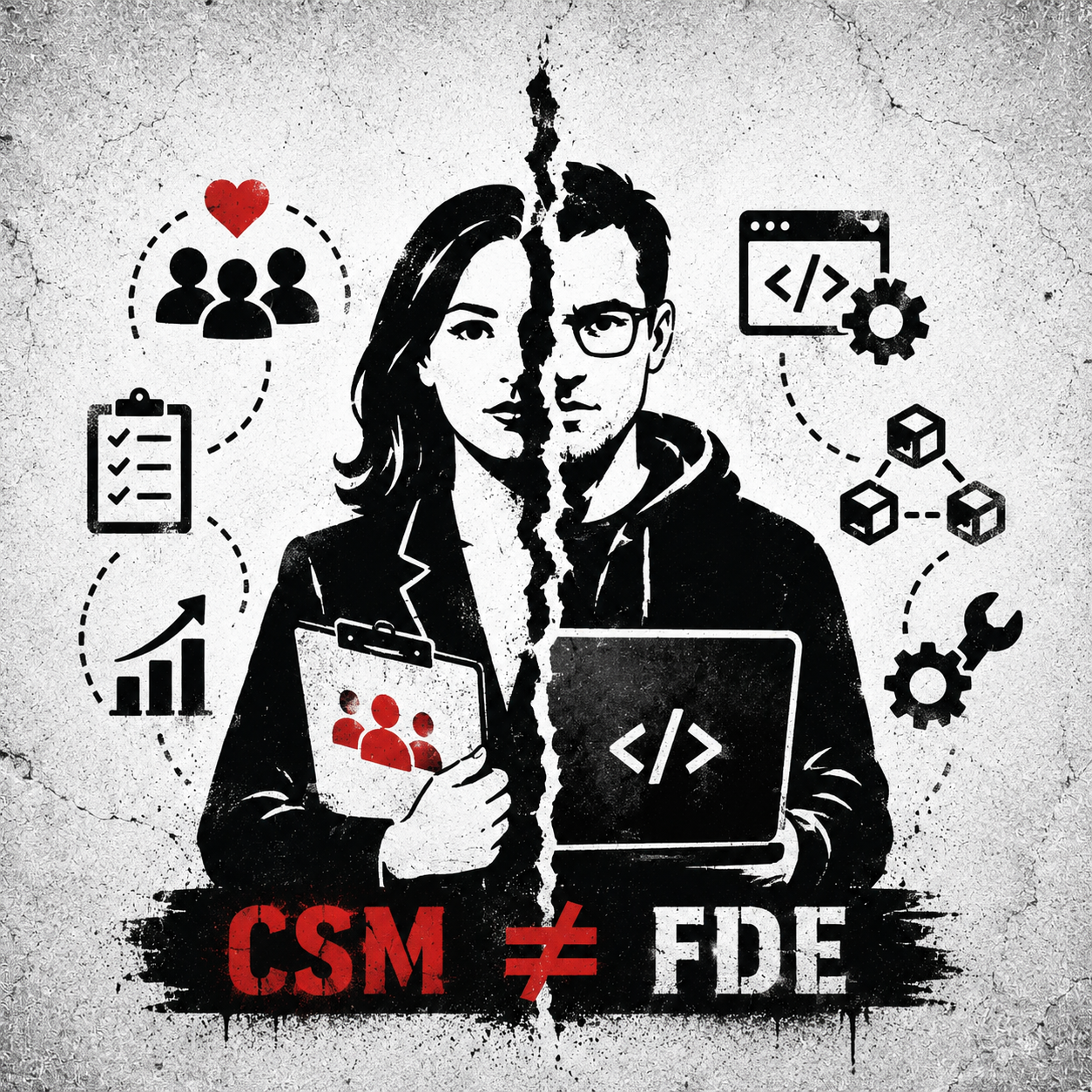
FDE and CSM are not the same job.
At a time when nearly every established market leader is facing competition from emerging startups, there isn’t a post-sales leader who isn’t rethinking how value gets delivered. That pressure is real, and it’s producing some shortcuts.
That distinction matters more now that Forward Deployed Engineer has become a LinkedIn trend and companies are rebranding their CS teams to sound more technical.
Titles can help open doors. They signal organizational priority, set customer expectations, and attract talent. However, what keeps those doors open is consistently delivering value and being able to articulate it to the right people at the right time.
That’s a function of the journey you build around your customer-facing roles, not what you call them.
A CSM who owns onboarding, adoption, and renewal needs different resources, tooling, and support than someone co-building a solution alongside the product and engineering team. Both are legitimate motions, but neither replaces the other.
In reality, CSMs regularly fill operational gaps in value delivery when the product is still catching up to customer needs. That’s real work, and it requires a different skill set than relationship management. CSMs that excel possess both in spades. On the other side, with the pace of AI development and the pressure to demonstrate durable ROI, FDEs are increasingly tasked with building the last mile of a product tailored to a specific customer or segment. That’s closer to product engineering than anything in a traditional CS job description. To qualify, that means actively contributing to a live or customer-specific codebase and shipping functionality to connect the product to the value it needs to deliver.
Are CSMs getting more technical? Absolutely. But that’s not new. It follows the same path as the Technical Account Manager in the SaaS and on-prem generations. The role evolved to meet the product. That’s different from redesigning the motion entirely.
For many companies with complex products, especially AI-native, hard tech, and infrastructure businesses, an FDE + AM motion likely makes the most sense, particularly as the business scales. For SaaS companies making the pivot with MCPs (model context protocols that connect AI systems to external tools and data) and headless offerings (where the core product logic is exposed via API, without a fixed front end), the answer isn’t a full rebuild. It’s rethinking value delivery by shifting solutions-oriented roles into an FDE function that complements the existing CSM motion, not replaces it.
Conflating the two creates org designs that serve neither customer well.
The better question isn’t “should my CS team be more like FDEs?” It’s “what do my customers actually need to get value, and have I built the support structure for my team to deliver that?”
Get that right, and the title follows.
Leave a Reply