
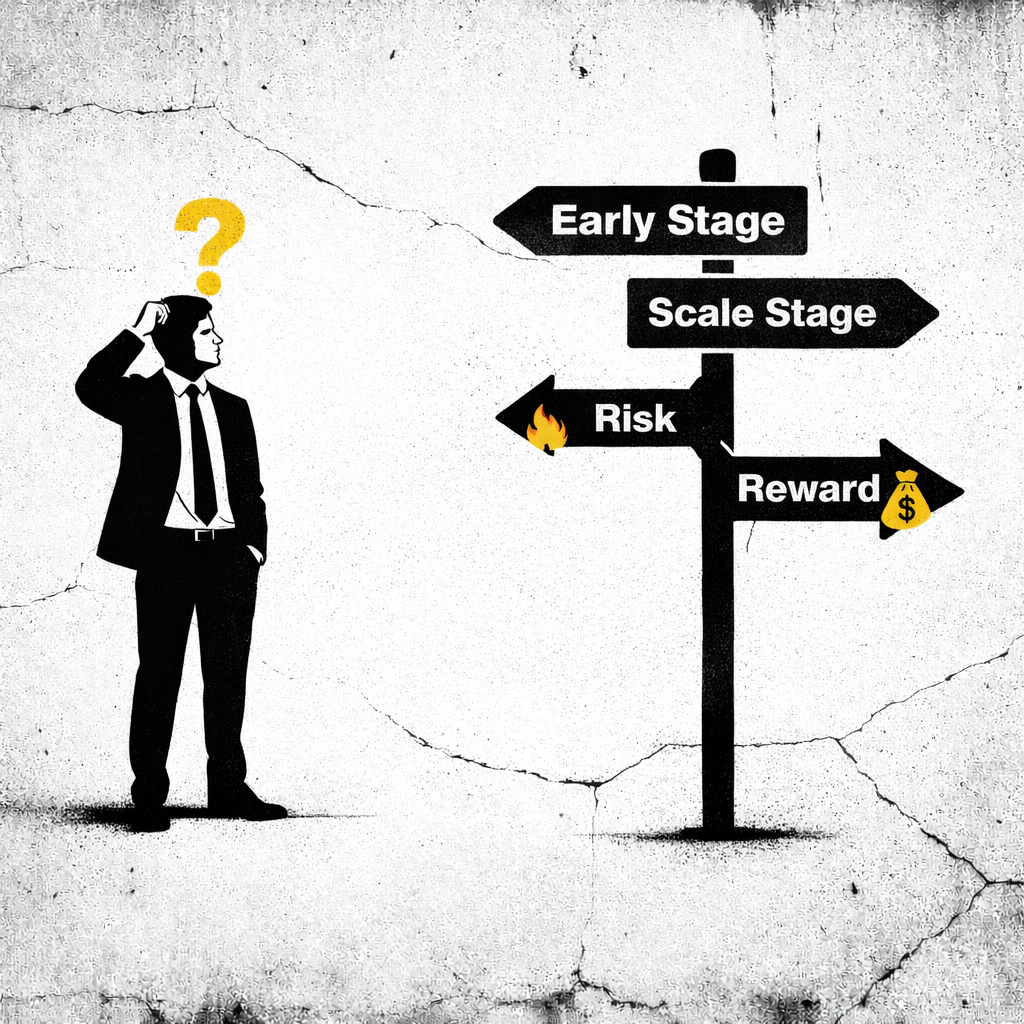
How I Evaluate Early and Scale-Stage Startups
I’ve spent more than 15 years inside startups.
In that time, I’ve been a co-founder, the first customer success hire, early sales and strategic account management, and part of leadership teams at many stages in between. I’ve helped build companies that were acquired for nine figures. I’ve also been in rooms where we fought hard, pivoted multiple times, and still ran out of capital.
Those experiences leave you with a mix of optimism and humility. Startups are emotional roller coasters. The same traits that create breakout success can also create painful failure. Over the years I’ve learned that excitement alone isn’t a strategy, and that great people can still be in the wrong market at the wrong time.
That’s why, when I explore a new opportunity today, I rely on a structured framework. It helps me balance instinct with evidence and evaluate companies consistently, not just emotionally.
I break my evaluation into eight areas.
Company fundamentals
I look at ARR and year-over-year growth, burn rate, and runway. I want to know how long the company has to execute its plan and whether the last fundraise sets them up to reach the next milestone. Market size and TAM matter too. Even the best team struggles in a market that’s too small.
Founders and leadership team
Founder-market fit is critical. Have they lived this problem before? Do they have experience scaling a company, not just starting one? I also pay attention to the strength of product, engineering, and growth leadership, how the organization is structured, and whether turnover suggests healthy or toxic management practices.
Product and differentiation
I want to understand the real value proposition, the competitive moat, and the strongest use cases today. How clean is the code base and key integrations? How much tech debt exists? Are there tight feedback loops from customers into the roadmap, and a predictable release process? How is customer feedback prioritized versus the vision for the product?
Customer traction
Clear ICP definition, strong GRR and NRR, and referenceable customers are leading indicators of long-term success. Proof of value beats theory every time.
GTM readiness (determines how fast the company can grow)
Is the sales motion inbound, outbound, or PLG? How mature is onboarding and enablement? What role does Customer Success play after the sale? Great products fail without a repeatable go-to-market motion.
Role scope and impact
I evaluate who the role reports to, key KPI’s and how they’re aligned internally, and whether the role is net new or backfill. I want to know how much influence, budget, and tooling I’ll actually control, especially for leadership roles
Cultural fit and values
Alignment on communication style, transparency, and decision-making often determines whether a role feels energizing or exhausting.
Upside and risk
Equity potential, path to the next fundraise, and key risks around churn, technology, or market dynamics all factor into the decision.
In addition to this list, I consider organizational maturity. Startups typically exist along a spectrum:
- Early-stage: Establishing foundational teams and processes
- Scaling: Functions in place, processes rapidly evolving, starting to standardize to support scale
- Established: Large matrixed teams, complex systems, strong governance and practices
- Advanced: Highly mature, benchmarked, focused on optimization
Understanding where a company sits on that spectrum helps me judge whether my experience is a good match for what they need next. Even if the timing isn’t right for a full-time role, there are often ways to get involved and add value, which can help build relationships and open doors for the future.
This approach is built from what I’ve learned over the years from books, articles, mentors, founders, and investors I’ve been fortunate to work with. By no means is this framework perfect or exhaustive. It’s simply a way to create a deeper shared understanding, whether that happens through a few hours of honest conversation, several days of discovery, or months of working together.
After a decade and a half in this world, I know no formula guarantees success. There are only people, markets, and moments in time. This process helps me choose the opportunities where I can add real value, enjoy the work, and where the journey, even with its risks, is worth taking.
Leave a Reply